The basilica's story
Our Lady of Mercy and Barcelona
Why the Basílica de la Mercè matters to Barcelona: the Order of Mercy, the patron saint, the 1687 vow and the festival that bears her name.
Book a seat under the dome ↗Quick answer
The basilica is dedicated to Our Lady of Mercy, patron saint of Barcelona. The Order of Mercy, founded in the city in 1218 to ransom captives, built the first church on the site in 1249. The city named her patron in 1687, and the Pope confirmed it in 1868. The festival La Mercè follows every September, around her feast on 24 September.
An order founded in Barcelona
The Order of the Blessed Virgin Mary of Mercy was founded in Barcelona, then the capital of the Principality of Catalonia in the Crown of Aragon. Tradition dates it to 1218, and the order's founder was Peter Nolasco. Its purpose was to ransom Christian captives held by Muslim forces, especially along the frontier with al-Andalus. The order's name, Mercy, refers to that work. Its first church in the city went up in the 13th century.
Peter Nolasco
Peter Nolasco, the founder, lived from about 1189 to 6 May 1256. According to the Order's history, it was formally constituted on 10 August 1218 at the main altar of the cathedral in Barcelona. Its constitutions of 1272 state the aim in plain terms: to visit and to free Christians who are in captivity. Our Lady of Mercy is the order's patron and, in time, Barcelona's. The basilica's own website carries pages on the order, on Saint Peter Nolasco and on the Mercedarian festivals and legends.
The legend of 1218
According to the legend that the city repeats, on the night of 24 September 1218 the Virgin appeared at the same moment to King Jaume I, to Saint Pere Nolasc and to Saint Ramon de Penyafort. She asked all three to create an order dedicated to saving Christians imprisoned by the Saracens. The feast of Our Lady of Mercy falls on 24 September, and Pope Innocent XII extended it to the whole Church in 1696.
The church on the square
The order's first church on the site, a medieval building, dates from 1249 to 1267 and was enlarged in Gothic style in the 14th and 15th centuries. The community later decided to demolish it and build a new church. The present Baroque basilica dates from 1765 to 1775, to a design by Josep Mas i Dordal, and its façade ornament is by Carles Grau. In 1918 Pope Benedict XV gave it the title of minor basilica, marking 700 years since the apparition to Peter Nolasco.
The vow of 1687
In 1687 Barcelona suffered a plague of locusts and placed itself in the hands of the Virgin of La Mercè. Once the plague was over, the Council of the City named her patron saint of Barcelona. The Pope did not ratify the decision for two centuries, until 1868, when Pius IX declared the Virgin of La Mercè patron. Wikipedia's article on the basilica says she has been patron saint since 1687, which matches the city's own date.
From devotion to festival
After the Pope's decision, Barcelona began to celebrate a festival in September. The city's account says the festival became a civic event in 1871, with popular celebrations for residents. Today La Mercè is a multi-day street festival with a programme centred on Mediterranean culture, including concerts, street arts, parades and traditional dances such as the sardana and the human castles. The streets around the basilica fill with people in late September.
What it means for your concert
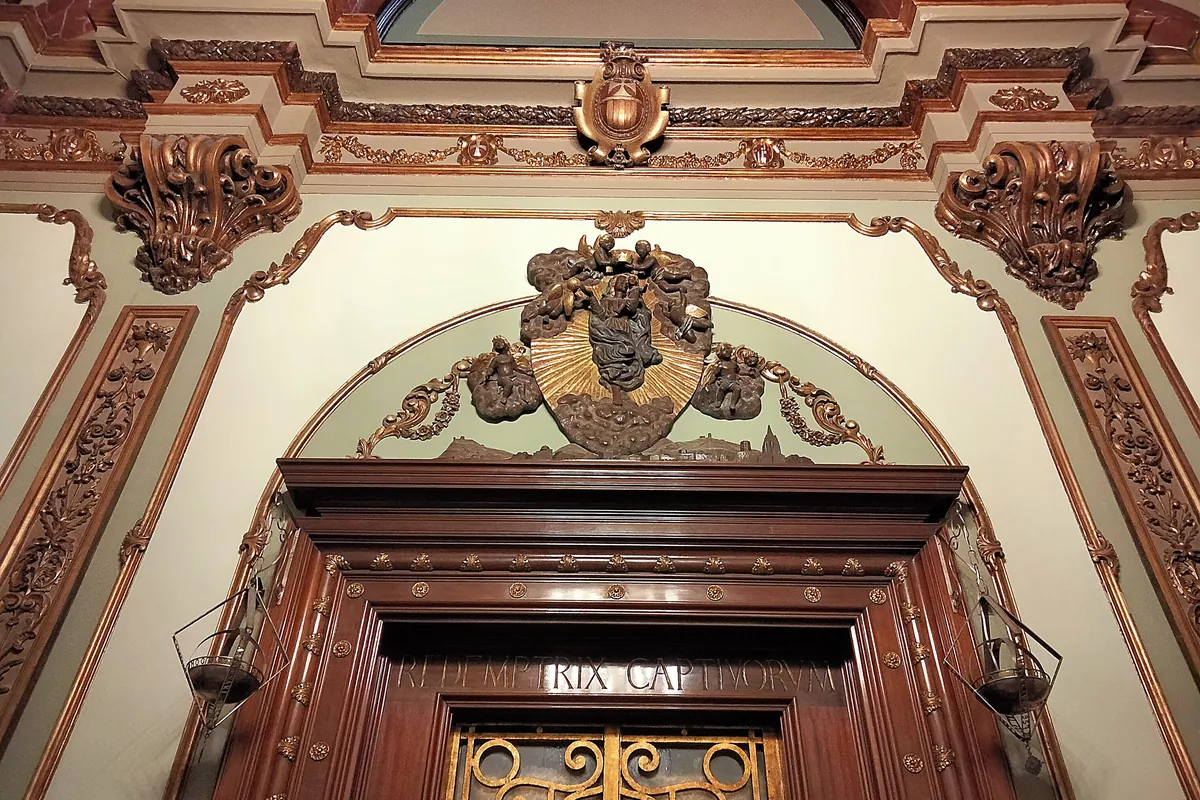
The Vivaldi concert takes place in the church that shelters the patron saint's carved image. Her feast gives the building its name, and the festival that bears her name draws the city to the same neighbourhood each year. Knowing this changes how the evening feels: the church is a working place of devotion first, so the audience is asked for silence, and the programme is the visitor's way in. A separate guide explains the building and how to get in.
Read next: La Mercè basilica: before you go
Frequently asked questions
Who is Barcelona's patron saint?
Our Lady of Mercy, the Mare de Déu de la Mercè. The city named her patron in 1687.
When is her feast day?
24 September. The city's La Mercè festival is held around it.
Is the basilica the cathedral?
No. It is a separate church, and it became a minor basilica in 1918.
Sources